

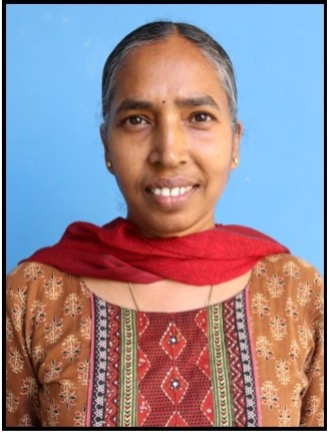
Designation: Assistant Professor
Email: geeagri@gmail.com; geetha.govind@uasbangalore.edu.in
Office Telephone: +91-9535523648
| Degree | University | Specialization |
|---|---|---|
| Post-Doc | National Taiwan University, Taiwan | Stress Biology and Chemistry |
| Post-Doc | Heidelberg University, Germany | Developmental Biology |
| Post-Doc | IPK-Leibniz Institute, Gatersleben, Germany | Stress Genomics/ Plant Architecture |
| Post-Doc | Max Planck Institute, Jena, Germany | Chemical Ecology |
| Post-Doc | University of Picardie, France | Stress Biology- Arabidopsis |
| Research Associate | University of Agricultural Sciences, Bangalore | Crop Physiology |
| Ph.D. | University of Agricultural Sciences, Bangalore | Crop Physiology |
| M.Sc. (Agri) | University of Agricultural Sciences, Bangalore | Crop Physiology |
| B.Sc. (Agri) | University of Agricultural Sciences, Bangalore | Agriculture |
My research focuses on developmental physiology, particularly tuberization in potato and inflorescence development in rice and finger millet. Potato is a traditional crop in Hassan, Karnataka, but declining profitability has led farmers to shift to alternatives such as maize, ragi, and ginger. Tuberization is highly sensitive to photoperiod and temperature, making it vulnerable to rising temperatures and heat waves associated with climate change. Our work focuses on understanding the molecular mechanisms regulating tuberization under elevated temperature conditions and its crosstalk with hormones. Using aeroponics systems and staggered sowing, plants are exposed to controlled temperature conditions, and aeroponics enables precise regulation of both shoot and root zone temperatures. We also investigate the role of hormones, particularly gibberellic acid, and their interaction in tuber formation, with functional validation of candidate genes through overexpression and down-regulation approaches, supported by efforts to standardize transformation protocols in potato. In parallel, we study plant architecture, especially inflorescence development in finger millet (ragi) and rice, where yield is largely determined by panicle architecture, particularly finger or branch number. Our work aims to elucidate the molecular basis of inflorescence architecture and its regulation under abiotic stress to improve grain yield and climate resilience.