
Year of Establishment: 1969
The AICRP centre, established in 1969, is a premier rice research center aligned with international standards. It is notably recognized for developing India’s first commercial rice hybrid, KRH-2, which was released by the CVRC in 1996.
The centre has developed and released 45 rice varieties and 2 hybrids suited to diverse agro-climatic conditions of the state. Notable varieties include CTH-1, CTH-3, Vikram, Mangala, Pushpa, Rasi, Prakash, Pragathi, Shakti, IET 7575, Mandya Vani, Jaya, IR 20, Kusuma, Suma, Mandya Vijaya, IR-30864, BR-2655, Thanu, and Raksha.
It has also released KMP-175 (Daksha), which is suitable for cultivation under aerobic conditions. In addition, the centre developed KRH-4, the first non-scented, medium slender, good-quality grain rice hybrid, released at the national level in 2015.
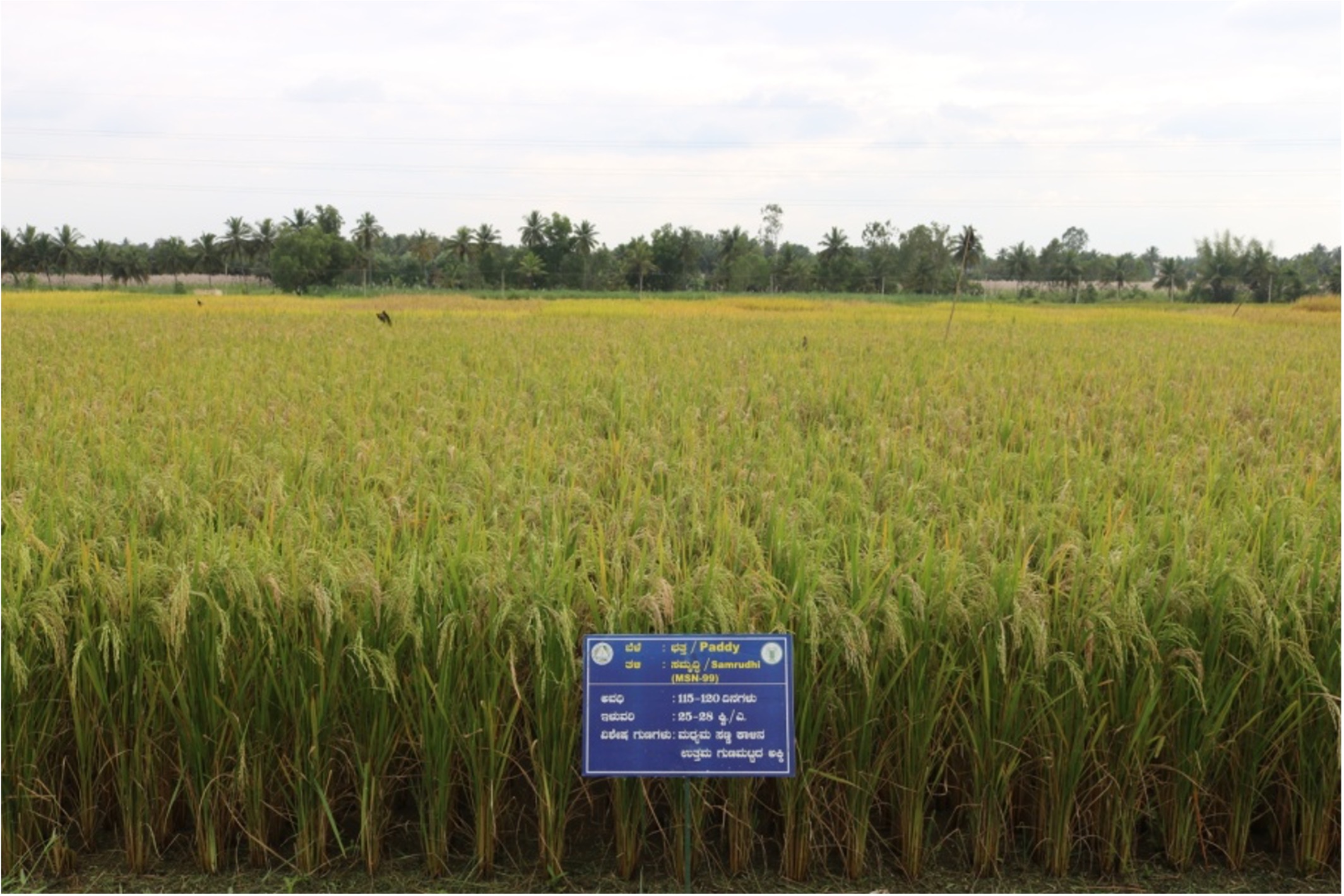
More recently, promising genotypes such as KMP-220 (Mandya Jyothi), KMP-225, and MSN-99 have been released for farmers’ cultivation.
The AICRP has also characterized and maintained more than 12000 traditional and other rice germplasm of India. The division established a state of the art Marker Assisted Selection (MAS) and Genetic Seed Purity laboratory to support precision breeding and ensure seed authenticity.
It has developed 47 production and protection technologies towards achieving higher rice productivity with lesser cost of production. The technologies include seed treatment for paddy, nursery preparation techniques, use of green manures, application of micronutrients, use of farmyard manure and fertilizers, water management practices, integrated weed management, integrated pest and disease management, chemical control measures for pests and diseases, rice-based cropping systems for the Cauvery command area, soil management practices including problematic soils, mechanized transplanting methods, drum seeder techniques for direct seeding and other improved crop production practices.
The water saving production technologies viz., SRI and aerobic method of rice cultivation are given to save irrigation water in rice production. Currently Alternate Wetting and Drying (AWD) method of irrigation practice in transplanted rice is recommended in Cauvery Command area to save 35 to 40% irrigation water. The centre is actively engaged in advancing mechanization and direct seeding technologies in rice.
The long –term study on use of organic and inorganic fertilizer in transplanted rice on soil health and crop productivity has been taken up for sustainable rice production.
The IPM and plant protection technologies for management of blast, brown spot, sheath blight, BPH, yellow stem borer, leaf folder etc. are developed to minimize the yield loss in rice.
Recently, Scientists from the University of Agricultural Sciences, Mandya visited international rice research institutions (IRRI), Philippines for to initiate collaboration through Memorandum of Understanding (MoU). The collaboration efforts are underway to develop and disseminate nutrient-rich, high-yielding, climate-resilient rice varieties and advanced technologies for the benefit of farming community.
Dr. G.R. Denesh
Agronomist and Scheme Head
Dr. V.B. Sanath Kumar
Pathologist
Dr. C.A. Deepak
Jr. Rice Breeder
Dr. Kittur Math M.S
Entomologist
Dr. Savitha H.R
Jr. Soil Scientist
Dr. Supriya S. M
Jr. Breeder (Hybrid Rice)
AICRP on Rice
Zonal Agricultural Research Station,
V.C. Farm, Mandya-571405
Email ID: grdenesh@rediffmail.com
M: 9448980134